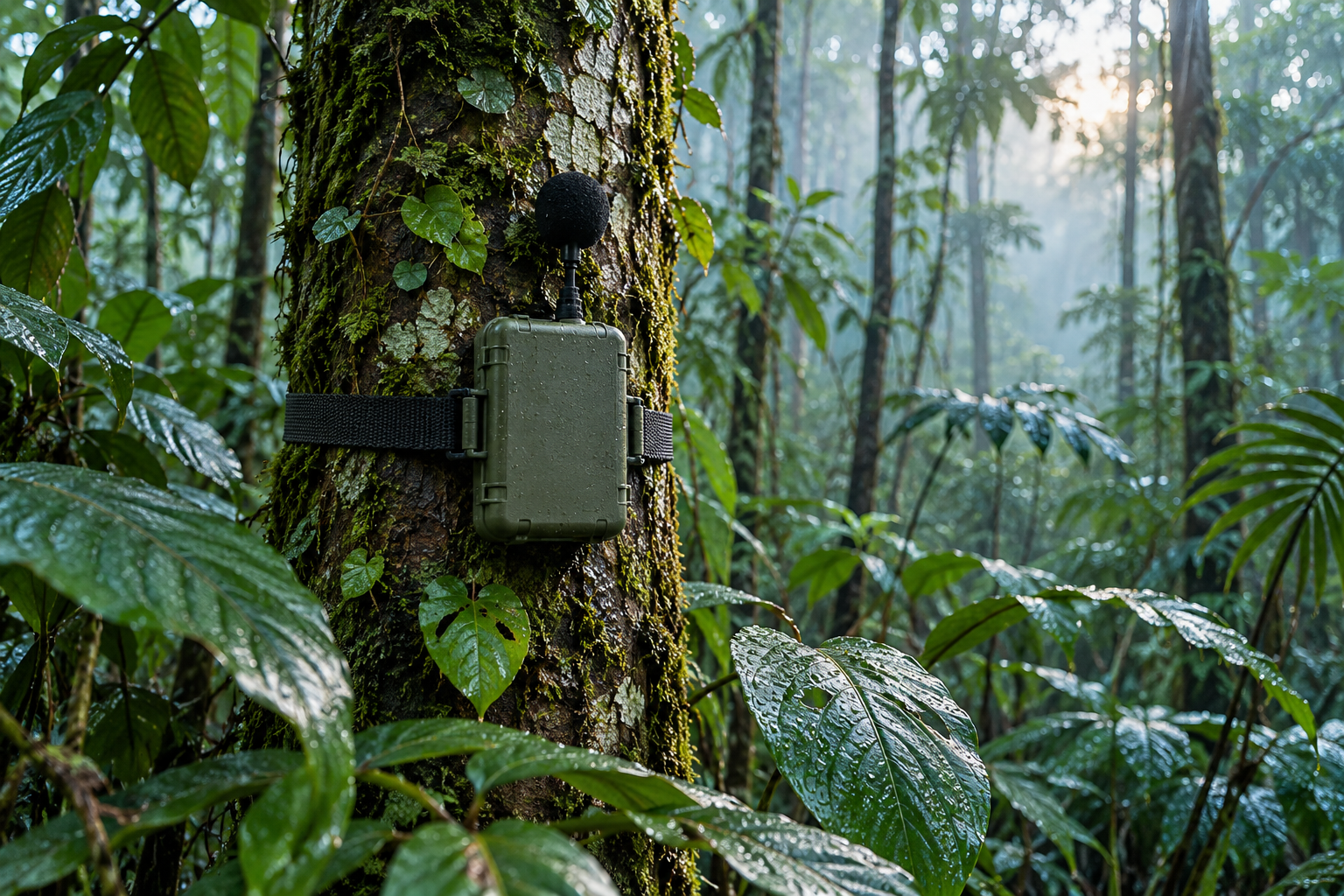
Two forests can sound equally busy and contain different animals. A few persistent callers can fill a recording; a larger community can include many species that remain quiet during the sample. Sound is ecological evidence, but its richness is not automatically a species count.
That distinction matters as microphones become increasingly useful conservation instruments. Recorders can sample when people are absent, retain evidence for later analysis, and reveal changes that brief visits miss. Their promise is real. So is the risk of turning a convenient acoustic number into a biological claim it has not been tested to support.
The strongest recent work suggests a productive shift in ambition. Recordings may tell us a great deal about changes in communities without functioning as universal biodiversity thermometers.
A revealing result from recovering forests
In Ecuador's Chocó region, researchers recorded sounds at forty-three plots spanning agriculture, regenerating forest, and old growth. Experts identified vocalizing vertebrates, while automated methods summarized recordings through acoustic indices and a bird-recognition model. The team also sampled nocturnal insects using metabarcoding. Their study of soundscapes and forest recovery found that community composition tracked the recovery gradient better than total vocalizing species richness.
The result is ecologically plausible but not trivial. An agricultural plot can contain many audible species, including animals associated with open or disturbed conditions. A recovering forest may become more similar to old growth through replacement of those species rather than through a simple upward march in the total count.
The automated bird model recognized only about a quarter of the species detected by experts, yet its representation of community composition was informative. That does not mean omitted species were unimportant. It means a partial community signal could correlate with the broader gradient in this study.
Importantly, the correlation with non-vocalizing insects did not make the microphone a direct insect census. Both communities could respond to shared habitat conditions. The recording served as an indicator whose usefulness was established by an independent comparison.
The hard test is somewhere else
A separate investigation tested acoustic approaches against bird-community observations across four datasets from the United States, Malaysia, Taiwan, and India. It used more than eight thousand recordings, analytic indices, and machine-learned sound features. The study of soundscape generalizability found some success predicting bird richness within datasets, but poor performance when models were transferred to datasets on which they had not been trained.
Soundscape change was more consistently associated with community change, although similar recordings could still accompany different bird communities. The authors suggested that broad acoustic monitoring might help direct detailed ecological surveys toward unusual changes rather than replace those surveys.
There is no necessary contradiction with the Ecuadorian results. A model calibrated to a particular recovery gradient can work there without transferring intact to another continent, habitat, recording system, or sampling protocol. Local validation and geographical generalization are different achievements.
For a conservation organization, the distinction affects procurement as much as statistics. A demonstration that a model recognized change in one forest is not evidence that it will count species in every project landscape. Before interpreting a new site, somebody must establish what the model's output means there.
Three different objects called a soundscape
It helps to distinguish the recording, its summary, and its biological interpretation. The recording is a captured pressure signal at one microphone. An index might summarize how energy varies across frequencies or time. The ecological inference might concern bird richness, community identity, habitat recovery, or disturbance.
Confusion arises when the three objects inherit one another's certainty. A precisely calculated index can rest on a weather-dominated recording. A well-classified bird call can document presence without documenting the number of individuals. A stable value can conceal replacement of one set of callers by another.
These are logical limits, not arguments against automation. Every survey observes through a filter. Human observers have their own detection limits, expertise, and sampling constraints. The useful question is which filter best answers the ecological question and how uncertainty is estimated.
A raw archive has particular value because interpretations can improve. A project that preserves recordings, timestamps, equipment information, and sampling schedules can revisit earlier claims as recognition methods change. A project that retains only annual scores loses that opportunity. This is a recommendation about evidence stewardship drawn from the methods' dependence on calibration, rather than a claim that archives solve every sampling bias.
Reconstructed histories require different language
One influential investigation combined bird-monitoring counts from North America and Europe with archived species recordings to reconstruct historical soundscapes. It found broad declines in acoustic diversity and intensity over recent decades. The 2021 spring-soundscape study used standardized rules to translate counts into synthetic audio, enabling comparisons over periods without equivalent continuous recordings.
Those are reconstructed soundscapes, not microphones retrieved from the past. The standardized construction cannot fully reproduce historical calling rates, weather, individual behavior, or background noise. Its strength is a consistent comparison of how changing bird communities could alter acoustic properties under specified assumptions.
That wording matters. Describing the work as if researchers directly measured decades of recordings would make its evidence seem different from what it is. Models can recover information that direct observations lack, provided the assumptions remain attached to the result.
Listen for a question, then choose a measure
For forest monitoring, I would begin with the decision the recording is supposed to inform. Detecting a particular rare caller, tracking recovery toward an old-growth community, and flagging unexpected disturbance require different analyses. A single headline score need not serve all three.
The Ecuadorian recovery study shows how informative calibrated composition can be. The transferability study shows why the calibration must be challenged. The reconstructed-history work shows how carefully defined assumptions can extend the time horizon. Together they make the field more interesting than the claim that louder forests are healthier.
A microphone gives us a durable encounter with a place. What we learn from it depends on asking a question the recording can answer. The forest need not sing in a universal numerical language for listening to become rigorous science.
A thought worth keeping?