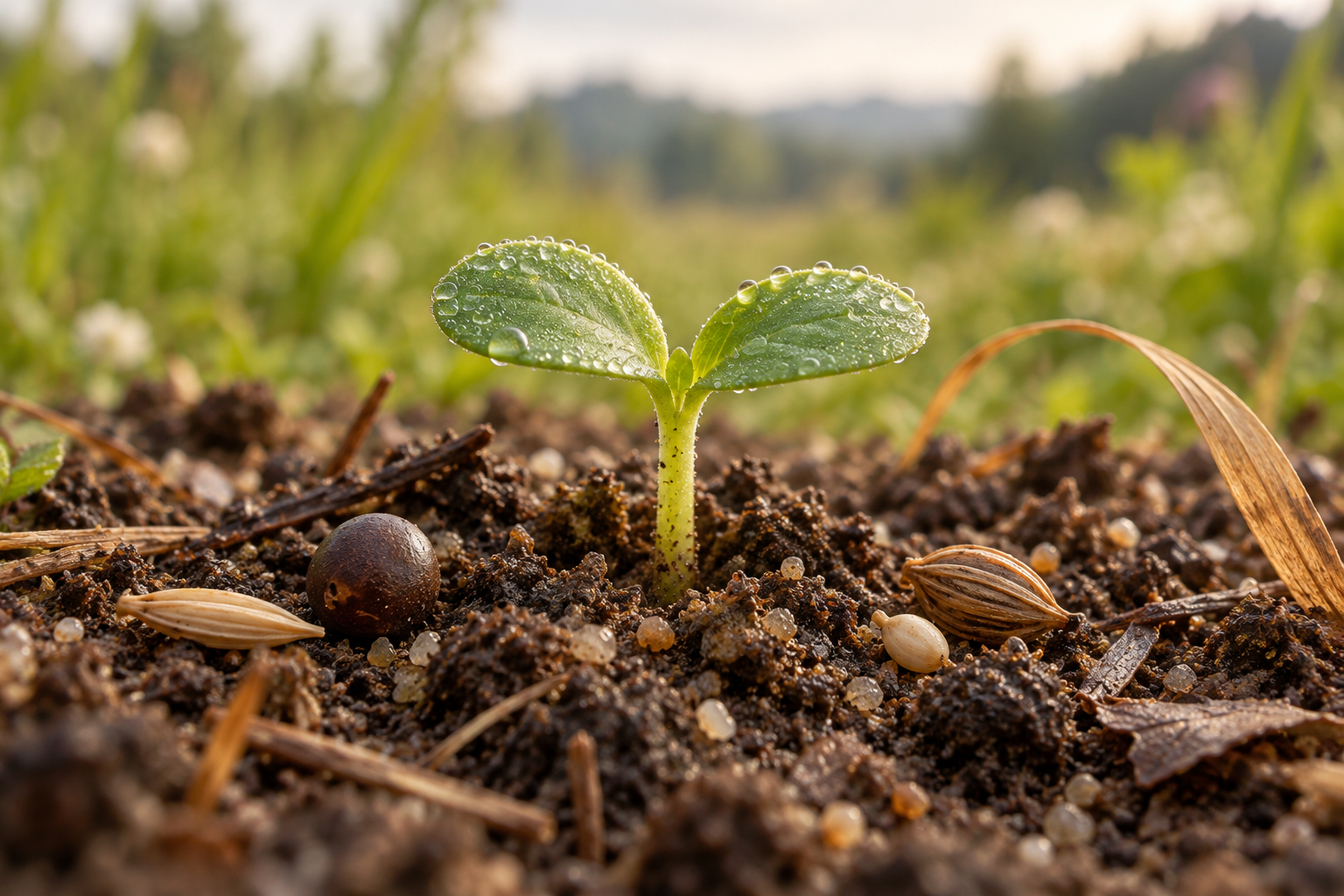
It is comforting to imagine a damaged grassland keeping a complete copy of itself underground. Stop the disturbance, let the seeds wake, and the former community will return. The soil becomes an archive with an intact restoration plan inside.
Real seed banks offer something more selective. They contain the viable seeds that arrived, entered the soil, survived, and have not yet germinated. Each of those steps filters the plant community. A seed bank can preserve possibilities missing from the vegetation above it, but it cannot be assumed to preserve every species that restoration would welcome.
Three kinds of evidence are especially useful here: experiments that alter environmental pressures, comparisons across land-use histories, and broad syntheses showing how much seed banks differ among places. Together they replace the buried-meadow image with a more useful question: which future plants are actually available?
A reserve can be depleted before the view changes
At Wardlow Hay Cop in Britain, researchers examined acid grassland exposed to experimental nitrogen additions over more than thirteen years. They found reductions in seed abundance and species richness in the soil, including changes that were not apparent in the same way in the standing vegetation. The long-term nitrogen deposition experiment also found no significant seed-bank recovery four years after additions stopped, even though flowering in one affected species had recovered.
This is not evidence that every nitrogen-enriched grassland has crossed an irreversible threshold. It is evidence that visible recovery and recovery of a buried reserve can follow different schedules. A plant flowering again must still produce viable seeds, deliver them to suitable places, and replace losses before its seed bank is replenished.
The study did not identify one exclusive mechanism. Nitrogen can influence seed production, germination, soil conditions, litter, and microbial processes. Several explanations were plausible, and the authors distinguished those hypotheses from what they had measured. That restraint is part of the finding's usefulness: the reserve was depleted even though its exact accounting remained unresolved.
A survey limited to green cover would have missed much of this change. A community can look present while having less capacity to reappear after the next drought, grazing episode, or disturbance. The implication is not that appearances are worthless, but that they describe one stage in a longer population cycle.
More seeds need not mean more possibilities
A separate experiment drew seed-bank samples from seven grassland sites across four continents, using nutrient-addition and herbivore-exclusion treatments. The Nutrient Network seed-bank study found that fertilization reduced species richness and diversity while total seedling abundance could increase. Herbivore exclusion modified abundance responses without providing a simple matching effect on richness.
Those results make two measurements worth keeping separate. Density asks how many seeds or emerging seedlings are present. Richness asks how many species are represented. A large reserve dominated by a few species is not equivalent to a smaller but compositionally varied reserve.
The experiment also found that fertilization made seed-bank and aboveground communities more similar. Similarity might sound reassuring, but here it can imply a loss of the reserve's distinctive contribution. If the soil stores only the same dominant species already flourishing above it, it offers fewer alternative responses when conditions change.
That interpretation concerns potential buffering, not a demonstrated prediction of every future disturbance. Seven sites provide useful geographical breadth, yet do not span all grasslands or all grazing histories. The study strengthens the case for measuring composition alongside seed numbers; it does not establish one universal seed-bank response.
Cultivation edits the archive
In northeastern China's Sanjiang Plain, researchers compared natural sedge meadows with soybean fields cultivated for different periods. Their study of farming duration and restoration potential found declines in wetland seed richness and density with longer cultivation. Important sedges disappeared from the sampled seed banks sooner than some other wetland plants.
The authors used those patterns to describe restoration-potential categories for their study system. Such categories are locally informative; they are not expiration dates for seed banks everywhere. Cultivation intensity, soil movement, species traits, and continuing seed inputs differ among landscapes. Farming duration is a clue to the history of filtering, rather than a substitute for sampling.
The greenhouse assay included drained and flooded conditions, which yielded different sets of emerging plants. This matters beyond that study. A germination assay reveals seeds that respond to the conditions offered. Failure to emerge can mean absence, but it can also mean that a seed's dormancy requirements were not met. The biological test and the conditions of the test must be reported together.
This does not make seed-bank measurements hopelessly ambiguous. It makes them interpretable. A carefully stated result might say that particular species did not emerge from specified soil depths under specified treatments. That is a stronger scientific sentence than announcing that the site's entire historical flora is gone.
The map is a starting point
A global analysis of soil seed banks assembled 15,698 records of richness and density. Its authors standardized differences in sampling season, area, and depth before modeling broad patterns. They also documented uneven geographical coverage and cautioned that sparse data could weaken regional predictions.
The labor of standardization is revealing. Two reports giving seeds per square metre may still describe different soil depths or times of year. Apparent differences between places can partly originate in how investigators looked. A global model helps generate expectations, but it cannot inventory an individual restoration field.
For decisions at that field, I would want three accounts kept alongside one another: the vegetation now present, the viable reserve detected in the soil, and the nearby sources from which missing species might arrive. That is a proposed way of organizing evidence, rather than a recipe guaranteed to restore a meadow. It prevents any single source of regeneration from carrying the whole argument.
The seed bank is valuable precisely because it gives plant communities another temporal dimension. Some possibilities wait underground while others depend on living adults, vegetative organs, or dispersal from elsewhere. Protecting that dimension means resisting two errors: assuming the reserve will save everything, and assuming that what cannot currently be seen has no value. The soil holds opportunities. Finding out which ones remain is part of restoration itself.
A thought worth keeping?