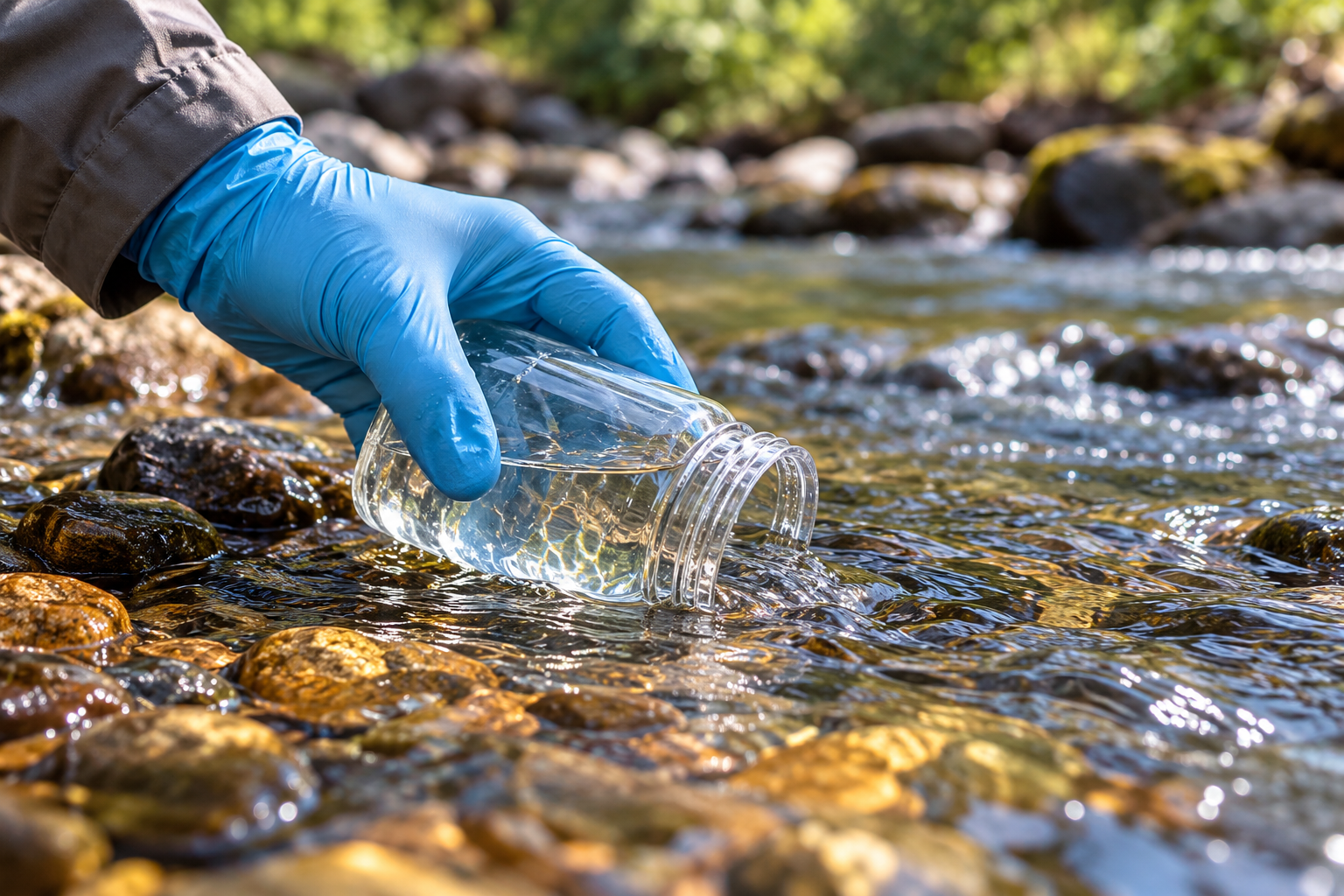
A bottle of river water can contain evidence of animals no observer has seen. It can also contain evidence that has traveled from somewhere else. Those two facts are central to environmental DNA's power and to its interpretation.
Environmental DNA, usually shortened to eDNA, is genetic material collected from an environmental sample. Researchers can target a particular species or use metabarcoding to identify many taxonomic groups. In a river, however, the molecules belong to a moving system. Shedding, transport, dilution, settling, degradation, and laboratory detection all stand between an organism and a reported sequence.
The right question is therefore not simply whether eDNA works. It is what kind of spatial and temporal evidence a particular sampling design can provide.
The river samples more than the riverbank
In Switzerland's Glatt catchment, Deiner and colleagues compared eDNA metabarcoding with conventional macroinvertebrate sampling and developed a model of how rivers integrate biodiversity information. Their 2016 conveyor-belt study detected a wide range of eukaryotic families, including terrestrial organisms, from river water. The eDNA samples and kick-net samples offered different pictures of diversity.
A kick net samples organisms in a defined patch of habitat. River water can carry material from upstream and across the land-water boundary. Finding more taxonomic groups in the water sample does not mean the net failed to count animals living in the identical patch. The methods partly sample different ecological spaces.
The study also exposed limits inside the analytical pipeline. Some groups detected conventionally did not pass the molecular assignment thresholds, and missing reference sequences affected identification. Broad taxonomic reach is not equivalent to complete coverage.
This is a useful way to treat a new monitoring method: identify the opportunity created by its different sampling footprint instead of insisting it reproduce an older method exactly. For catchment surveillance, integration can be a benefit. For locating one small population, the same integration requires additional work.
Distance is a property of the system
Research along the Rhône examined fish eDNA across a large river and compared molecular results with traditional electrofishing records. The 2018 large-river study found broad biodiversity patterns despite downstream transport. DNA associated with lake-dwelling whitefish was detectable far downstream from lake outlets, and modeling connected transport scale with river hydraulics.
The authors acknowledged that occasional whitefish in the river could affect estimates attributed to transport alone. Their comparisons with historical electrofishing records also did not create perfectly simultaneous censuses of identical spaces. These qualifications matter when interpreting exact distances or differences in richness.
The larger lesson is that there is no universal radius around an eDNA sample. Depth, velocity, particle behavior, source strength, and degradation can change how much upstream information remains detectable. A detection distance measured in a small stream is not automatically applicable to a deep, fast river.
It is also important to distinguish a maximum observed detection from an expected sampling footprint. An exceptional downstream detection does not mean every species contributes equally from that far away. Most samples integrate a mixture of nearer, stronger, older, and weaker signals.
Transport does not erase every local pattern
A 2024 investigation combined intensive sampling of Wales's River Conwy with samples from four other rivers in Europe and North America. It used several genetic markers and repeated Conwy sampling across a year. The spatiotemporal river biodiversity study detected spatial community turnover and seasonal events, while an introduced mackerel-DNA source helped examine downstream transport.
The transport signal differed between markers. In the experiment, one marker detected the introduced source farther downstream than another. Fragment length, marker specificity, and other analytical differences can affect what persists as a detectable observation.
Crucially, the researchers still found ecologically meaningful patterns rather than a lower river reduced to an indistinguishable mixture of all upstream life. This prevents excessive skepticism. The existence of transport does not make eDNA useless for local or seasonal ecology; it makes the relevant resolution something to establish empirically.
The study's strongest temporal replication was in the Conwy, while the additional rivers were sampled at one time point. Its conclusions about seasonal dynamics therefore rest on a different distribution of evidence from its cross-river comparisons. The sampling effort is part of the interpretation, not a technical detail to discard after reading the abstract.
A positive molecule and a local animal are different claims
The US Geological Survey's guidance on communicating eDNA results distinguishes detection errors in samples from mismatch between DNA presence and an organism's physical presence at a site. Transport, old sediment, and unintended transfer can produce the latter without a laboratory instrument malfunctioning.
This distinction helps avoid an unhelpful dispute over whether a detection is “real.” A sequence can be genuinely present while its ecological source remains uncertain. Conversely, failing to detect a sequence does not demonstrate absence when sampling or amplification has imperfect sensitivity.
For reporting, the wording should follow the evidence. “DNA assigned to this species was detected in these samples” is a different statement from “a breeding population occupies this reach.” The second may be supportable, but it needs a larger chain of observations or an explicit model that links detection with occupancy.
Read counts require similar care. The number of sequences produced by an assay is influenced by shedding, transport, amplification, and processing. It should not quietly become a head count of fish. Quantitative relationships can be calibrated, but they must be demonstrated for the intended setting and method.
Keep the journey attached to the evidence
A useful eDNA record therefore includes more than a species name. Location, date, flow conditions, sample replication, markers, controls, and assignment rules help another investigator understand what was observed. Repeated sampling can reveal whether an isolated signal persists or follows a seasonal pattern.
This is not a demand that molecular methods solve every uncertainty before contributing to conservation. Conventional surveys also miss organisms. The point is to preserve the connection between a sensitive detection and the ecological question it answers.
River water can carry an extraordinary biological message. Reading it well means acknowledging that the message has traveled. The travel history is not noise to be wished away; it is part of the river's ecology and part of the evidence.
A thought worth keeping?