On a lighting plan, an unlit strip may appear as a gap between fixtures. For organisms moving, feeding, and reproducing at night, it can be a habitat condition. The ecological difference is not merely whether a human observer can see the ground.
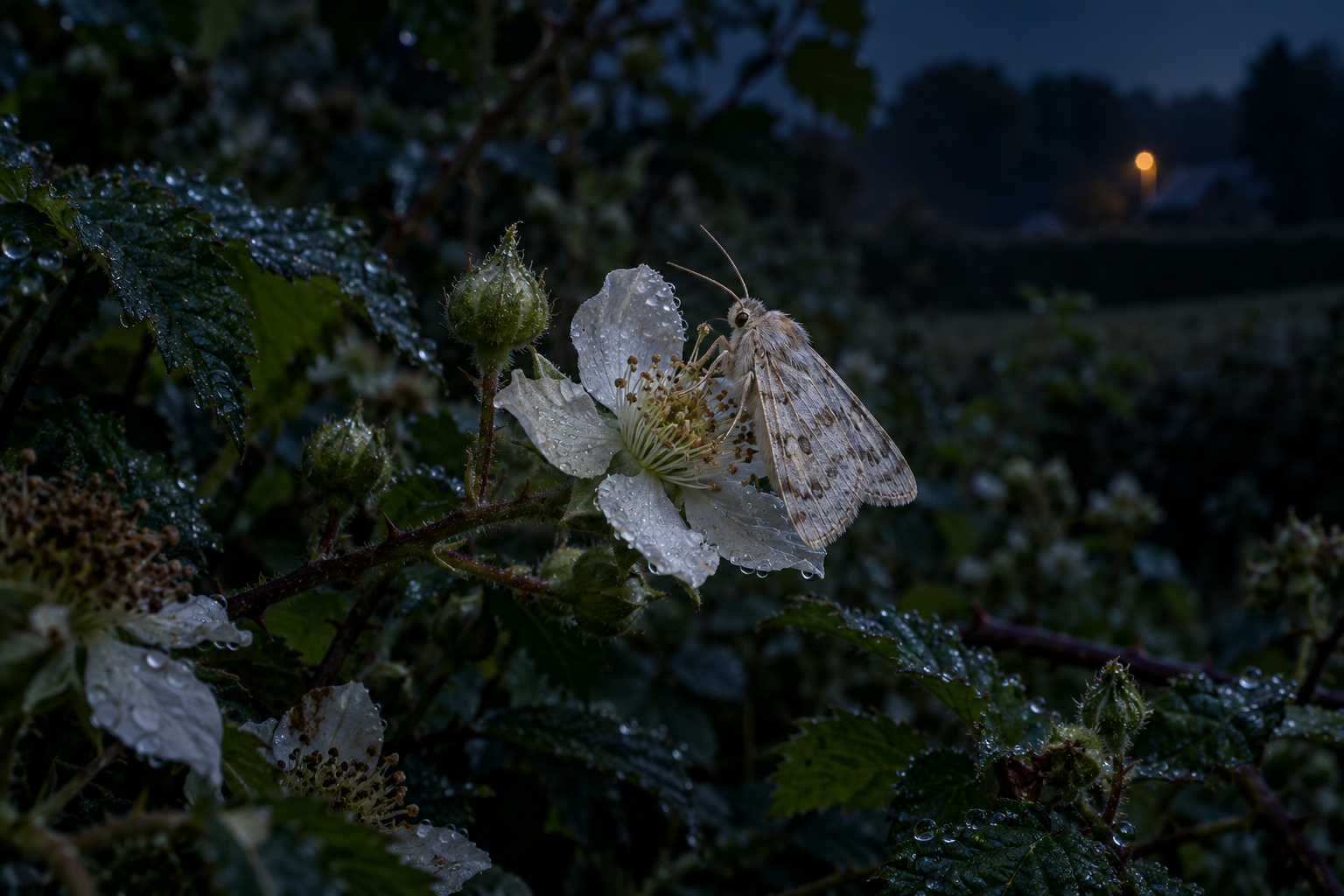
That makes artificial light an unusual pressure. It can alter the use of a place without removing the vegetation that makes the place look green. A hedge remains standing while its insects experience different feeding conditions. A meadow retains its flowers while the timing and identity of visitors change.
Research on light at night therefore challenges a narrow idea of habitat protection: keeping the physical object while changing the conditions under which its relationships occur. The most revealing studies follow those relationships beyond the conspicuous insects circling a lamp.
Look below the flying adults
Boyes and colleagues compared lit and unlit sections of similar hedgerows and grass margins in southern England. They focused on moth caterpillars, a relatively sedentary life stage, rather than counting only mobile adults attracted to lights. Their 2021 street-lighting investigation found substantially fewer caterpillars in illuminated habitat, with overall reductions of 47% in hedgerows and 33% in grass margins.
The main comparisons were matched observations around established streetlights, not randomized installation of the entire lighting network. Careful matching reduces alternative explanations without eliminating every unmeasured difference. A short-term lighting experiment within the same study added evidence of altered caterpillar feeding behavior.
The result cannot assign a fixed share of global insect decline to artificial light. It concerns particular local assemblages and conditions. Its strength is that it looks beyond a highly visible behavior to a less mobile stage that tells us more about the population using the habitat.
That shift also changes what counts as a reassuring observation. Fewer adult moths attracted to one lamp technology would not, by itself, prove fewer ecological effects. Attraction is one response among many. Development, feeding, reproduction, and survival may follow different patterns.
The following day is part of the night experiment
Giavi and colleagues experimentally illuminated six unmanaged meadows at night and compared them with six dark controls, recording daytime plant-pollinator interactions. Their 2021 meadow experiment found that effects depended on plant species and visiting insect group. Some plants received fewer visits, one received more, and visitor composition could change even where the total number of visits did not.
This is more informative than saying that light uniformly reduces pollination. A flower visit is itself a proxy: visitors differ in how effectively they transfer pollen. The study measured interactions, not all the consequences for future plant populations.
The mechanisms also remained partly unresolved. Changes in plant traits, herbivory, nocturnal visitors, or other indirect routes might influence daytime visits. The experiment demonstrates a treatment response without establishing one exclusive pathway for every species.
The ecological implication is nevertheless substantial. A pressure applied at night can leave a signal during the day. Monitoring only nocturnal activity could miss part of the response. Conversely, finding busy daytime flowers would not establish that nighttime illumination is irrelevant to the network.
An unlit patch is not necessarily a control
A separate experiment placed potted plants in directly illuminated areas, dark areas adjacent to lights, and dark control meadows. The plants included white campion, whose moth visitors can both pollinate flowers and lay eggs whose larvae later eat seeds. The study of effects beyond illuminated areas found higher seed-predator infection in the adjacent dark treatment and a lower measure of relative reproductive output there compared with dark controls.
This was a small field experiment involving two plant species, with an additional laboratory investigation of moth behavior. Its outcomes do not define a universal distance of influence around every lamp. They show that indirect effects can extend beyond the bright footprint in a particular interaction system.
The dual role of the moth is especially revealing. Calling an organism either beneficial pollinator or harmful seed predator would give an incomplete account. The plant's outcome depends on the balance of interactions. Changing where the moth visits and lays eggs can alter that balance without producing one simple response everywhere.
It also means a nearby dark patch cannot automatically be treated as unaffected. Animals move between lit and unlit areas. A good experimental control has to be justified by ecology, not merely by a light meter registering a lower reading.
Color changes responses, not the need for evidence
In a Dutch field experiment across eight sites, researchers compared bat activity under white, green, and red illumination with dark controls. Their study of spectral effects on bats found different responses among bat groups: some avoided white and green light, while opportunistic feeding species became more active around those lights. Red illumination produced responses closer to darkness for the groups studied.
This does not establish red light as harmless to all organisms. It concerns particular bat groups, light intensities, and field conditions. Activity around a lamp is also not a direct measurement of population growth. The result supports taking spectrum seriously while resisting a universal ecological safety label for one color.
A lighting decision can therefore ask more than which bulb looks least intrusive. Where does light fall? During which hours? Which organisms and interactions are likely to be exposed? Could a route or refuge retain darkness? These are questions suggested by the studies, not a claim that one design rule answers every site.
The value of darkness is easier to defend when it is described positively. It offers a set of conditions under which organisms have evolved ways to navigate, avoid predators, find food, and interact. Evidence of diverse responses is a reason to preserve those conditions where possible, rather than assume a green-looking place has remained ecologically equivalent after illumination.
A dark hedge is not an unfinished lighting project. It is a place whose nighttime relationships still have room to operate. Whether a specific intervention preserves those relationships is a question for observation, but recognizing them is where a more complete account of habitat begins.
A thought worth keeping?