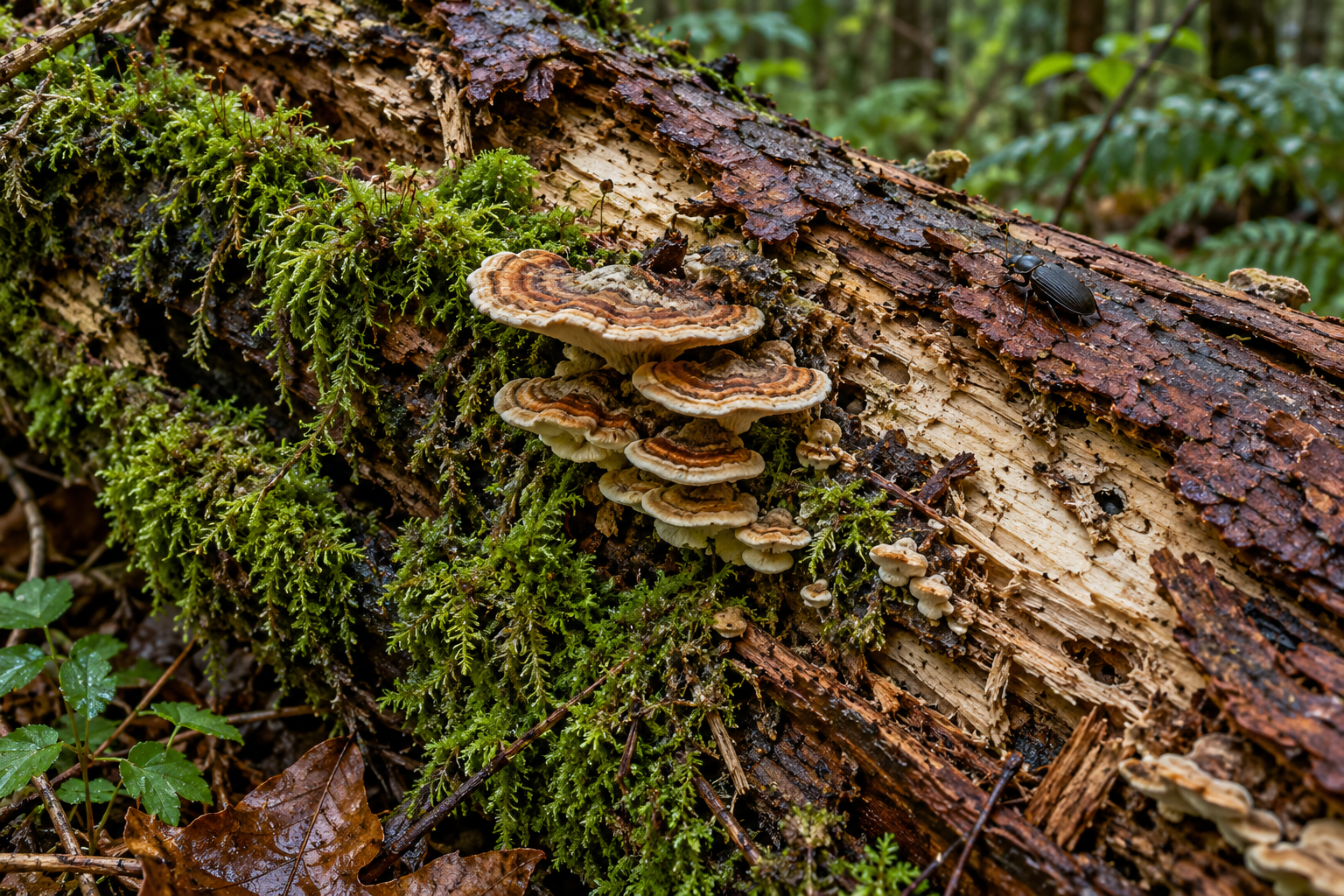
A log can be described as a quantity of carbon or as a place to live. Neither description is wrong, but each becomes misleading when it is allowed to erase the other. The carbon is held in material that organisms are changing; the habitat changes as that material decomposes.
This makes deadwood a particularly revealing part of a forest. Its ecological value is not confined to one final state called decay. Fresh bark, firm heartwood, moist interiors, tunnels, fungal territories, and nearly disintegrated wood offer different conditions. A forest containing a continuous supply of such stages is doing something that a single pile of recently cut branches cannot fully reproduce.
The research becomes interesting where organisms alter those stages in unexpected ways. More decomposers do not always mean faster decomposition, and the same type of wood does not behave identically in different places.
Similar counts can conceal different communities
A field study of European beech and Norway spruce logs used bacterial DNA sequencing to examine communities at different stages of decomposition. The researchers found no overall difference in bacterial operational taxonomic-unit richness between the two tree species, but wood properties and decay stages were associated with community composition. Their study of bacterial diversity in deadwood linked those differences with factors including moisture, pH, remaining mass, and carbon-to-nitrogen ratio.
An operational taxonomic unit is a sequence-based grouping, not necessarily a one-to-one census of formally named species. Nor does detecting bacterial DNA establish what every organism was doing. Those qualifications limit the claims about function that can be drawn directly from the data.
Even so, the distinction between richness and composition is important. Two logs may contain similar numbers of bacterial groups while hosting different assemblages. “How much biodiversity?” becomes more informative when accompanied by “which organisms, under which conditions?”
This is one reason that deadwood volume alone cannot describe the entire habitat resource. Volume is measurable and useful, but it compresses wood from different trees, decay stages, and physical settings into one total. The bacterial study does not establish a universal management target. It shows why apparently equivalent quantities need not be ecologically interchangeable.
Diversity need not make the machinery run faster
In a subtropical Chinese forest, another team paired fungal metabarcoding with measurements of carbon dioxide emitted by naturally decomposing wood. During warm-season measurements, wood with more diverse fungal communities tended to emit less carbon dioxide. The 2016 fungal-diversity study proposed interference among fungi as a possible explanation, while emphasizing the need for controlled tests.
The association was not uniform across every sampling date. It was also observational: the investigators did not randomly assign naturally assembled fungal communities to otherwise identical logs. Shared environmental conditions, colonization history, and properties not fully captured in the measurements remain relevant to interpretation.
The result still challenges an easy metaphor. A decomposer community is not simply a larger team cooperating to dismantle a tree. Organisms compete for territory and resources. Energy spent defending territory may not have the same consequences as energy spent acquiring new substrate. A process called decomposition emerges from relationships, not just from adding up consumers.
It would be a mistake to turn this finding into a prescription for maximizing fungal diversity to slow all forest carbon release. The study supports a relationship under particular conditions and a mechanism worth testing. Its broader lesson is that biodiversity can influence the pace and duration of habitat, with a direction that cannot be guessed from a simplistic division between useful growth and waste disposal.
Wood identity meets local climate
A two-year experiment in South Korea compared pine and oak deadwood across regions, including treatments excluding invertebrates. Pine mass loss varied more strongly among regions, and termite damage was concentrated in the southern region. Oak did not show the same sensitivity to invertebrate exclusion. The microclimate and exclusion experiment therefore found an interaction between wood identity, location, and decomposer activity.
Because the study ran for twenty-four months, its findings concern early decomposition. The relative contribution of animals and microbes may change later. Mesh exclusions also test an experimental contrast rather than recreating every feature of an undisturbed forest floor.
Within that frame, the study helps explain why a rate measured for one wood type and climate is an unsafe universal constant. Initial material matters, but so do the organisms able to reach and consume it. Temperature can act partly through those organisms rather than solely through direct effects on chemical reactions.
A larger experiment across fifty-five forest sites on six continents likewise found strong geographical differences in insects' net contribution to wood decomposition. Its global estimates were modeled from experimental relationships and mapped deadwood stocks. They describe a major carbon-cycle process; they do not turn a local log into a predictable countdown timer.
A forest needs time as well as material
These studies suggest a useful way to think about deadwood conservation: as continuity of changing conditions. Retaining material now can support a sequence of habitats, while future tree death supplies new stages. The scientific papers above do not specify a single ideal mixture for every forest. The continuity argument is an inference from the fact that communities and processes differ with substrate, environment, and decay.
It also changes how one might evaluate a neatly completed habitat project. The question is not only whether wood was added. What kinds were added, what stages already existed, and will new material arrive before present stages disappear? A one-time delivery and an ongoing ecological supply are different commitments.
Carbon accounting and biodiversity accounting can help one another here if their limits remain visible. A carbon stock records how much material is present. A decomposition measurement describes a rate over an interval. A community survey describes organisms detected through a particular method. None alone captures the whole life of the log.
Deadwood asks us to pay attention to transitions. The tree's death changes its ecological relationships rather than ending them. Some inhabitants help dismantle the address; others live in the conditions that dismantling creates. To retain the log is to retain part of that unfolding history, including outcomes a tidy forest floor has no room to show.
A thought worth keeping?